What's So Hard About Making Games?
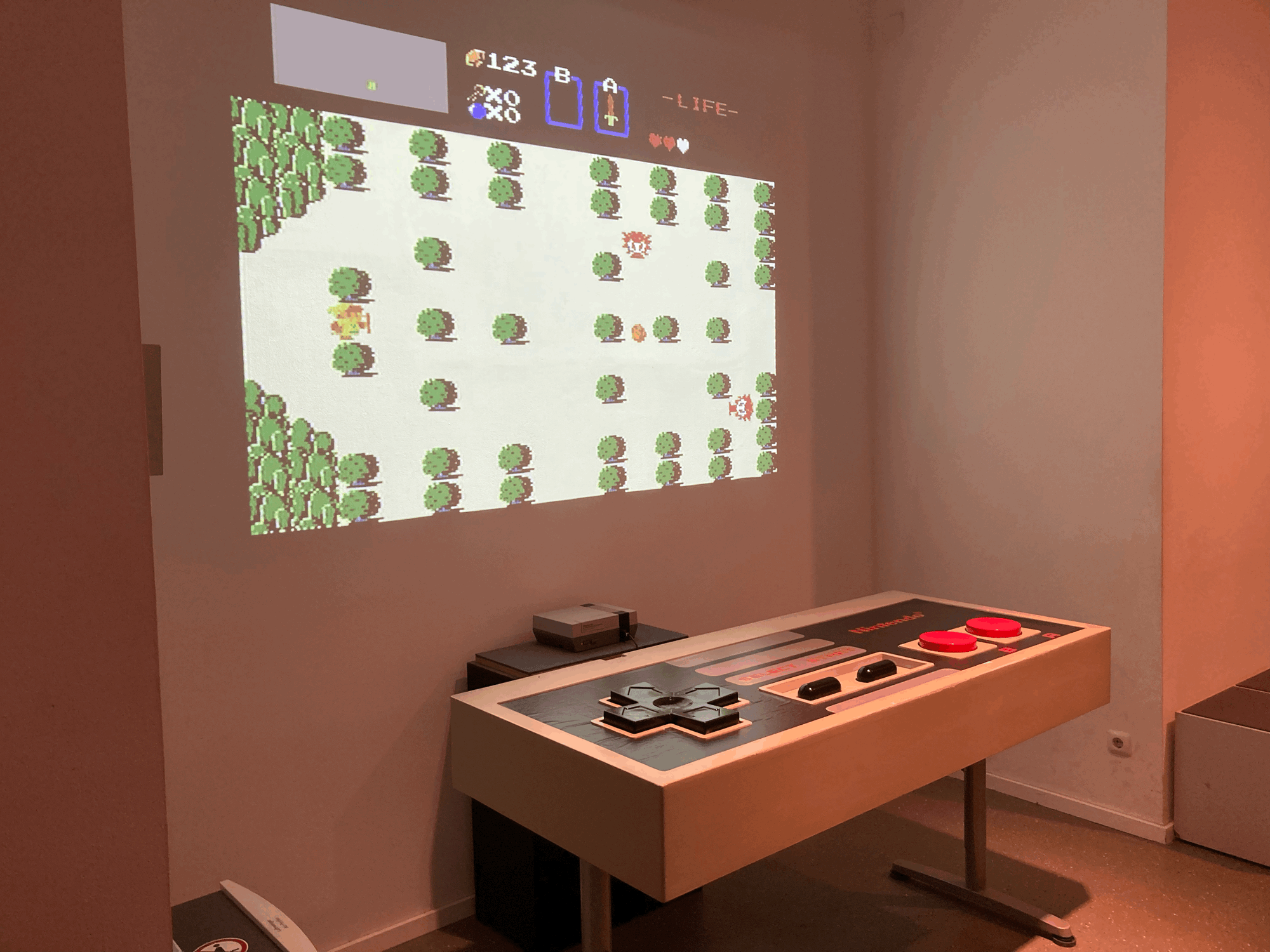
Although the group of people who play digital games has arguably grown to be much broader and more diverse over the last two decades, until recently it was a widely held belief that digital games were toys for children. It has been my experience that this attitude toward the digital product also extends toward the factory. I have had a few personal experiences where people have asserted to me that functional software must be more challenging to produce or otherwise more worthwhile as a pursuit.
Throughout these posts I've spent a lot of time establishing that software is not one bucket of homogenous goods. (see commoditisation and differentiation) As a special treat to myself, I am going to make a broad generalisation: digital games are more difficult to produce than other kinds of software. A small game is more sophisticated than a small app, a large game is more sophisticated than a large app, and so on. Games take all of the concerns about software that I have covered to date, amplify some of them, and add a few more on top to boot.
One of the more obvious pieces of evidence for games as a class of product requiring more attention than other kinds of software is that the realised digital (game) product tends to engage the mind and the body more broadly. Art direction (including setting, animations, visual style, sound effects, music), control schemes, game design, input devices, narrative storytelling work together in concert to form an experience that is intended to evoke a set of emotional responses. When I wrote about subjective software I stated that it is an ideal where the field of imagined experiences is large. There is nowhere that it is larger than in digital games.
In that post I also spoke to the role of adjacencies, such as marketing. I've spent a lot of time talking about challenges in software across various posts but I want to take a moment to highlight an opportunity - digital games and marketing have a special relationship due to the multiple modes of engagement I referred to a moment ago.
These modes of engagement are transferrable across different kinds of media, resulting in a dynamic where you can simultaneously establish confidence in the business, the intellectual property, the project independently of the digital factory and the digital product. It is common to represent in-progress digital games with proxies for the factory such as cinematic video footage designed to evoke anticipation among other feelings that the realised digital product will aim to evoke. There we have another key differentiator from other kinds of software - although concerns relating to the imagined and perceived experience may apply, games are largely about vibes, and often not over a moment, but over the course of many hours.
I've mentioned device-level risks a few times, and the operation of digital games tends to be relatively expensive computational work. For reference, you can picture concerns raised in the article about memory pressure and "turn it up to 11" out of 10. Device-level risks are so prevalent that in some sub-domains consumers have been trained to expect that software simply will not function normally if their device does not meet certain performance-related pre-requisites. The market for specialist hardware, digital games consoles, exists because from a supply perspective a known hardware and software configuration is much easier to make reliability guarantees against than a field of millions of permutations of PC builds, and from a demand perspective because it is easier to buy one product off of the shelf than engage with that very same field to make dozens of purchase decisions.
Technology choice is an interesting topic and I think there is something to be said about economies of scale (or lack thereof) but there's a particular aspect that relates to computing hardware that I would like to focus on. The digital console market has historically had distinct generations where the capability to render more sophisticated imagery (among other things) has improved. This improved capability shaped an expectation that the downstream software will see a commensurate improvement, and eventually this expectation would put downward pressure on demand for legacy markets and also create new ones (e.g. remakes, remasters) but what it also did was increase the cost of production while the expected price more or less remained the same.
The perception of value of digital games is a major issue in a more general sense for several reasons, one is that because games are competing largely on vibes, they are competing with all kinds of products in physical and digital space. Another is that many products don't leave the market, even when companies go out of business their catalogues may be acquired and managed as part of an asset portfolio, and if this does not happen they will still probably live on through black markets for software. One more is that sales are extremely common. It is a norm of contemporary games markets that products that have long recouped their production costs (of tens of millions, hundreds of millions) are made available for less than ten dollars, multiple times a year, every year.
The precocity of the demand for games has flow-on effects for the overall stability of the sector, which includes labour markets. The dominant model of software as product combined with market instability results in a dynamic where many practitioners simply do not get the opportunity to improve at their craft, or the rate at which they are able to improve is impaired at scale relative to other professions. The average career in the industry is laughably short, and this no doubt has some effect on the market even if other factors may ultimately be more dominant.
There are a few concerns that make engineering in games in particular more difficult, the technical primitives are generally more granular than many other modern domains that utilise code. Access rights for common primitives is more strict and in some cases protected by non-disclosure agreements and gatekeepers. Digital supply chains for games projects see less benefit from economies of scale.
It is my personal opinion that making games is the highest form of software development from a craftsmanship perspective, and many of the hardest-working, intelligent and creative people that I have met have been people making games and I am extremely sympathetic to their circumstances.
Until next time.